Thursday, October 21, 2010

Montauk Daisies - October 2010

Montauk Daisy - Chrysanthemum Nipponicum


Two years ago in October I was taking a drive in the countryside in Western New York when I passed a farm that had an enormous display of white flowers for sale. I made a U-turn and stopped. I had never seen these flowers before – they were not exactly chrysanthemums and not exactly daisies. Thus I was introduced to the Montauk Daisy, named after Montauk, New York, which is a city on Long Island.


They were beautiful, looked very sturdy and best of all they were $3 for a gallon size pot. I purchased 5 of them and placed them in various parts of my garden not really knowing what to expect.

Well, the outcome has been amazing. They have grown about 3 feet high and maybe 4-5 wide
As its current Latin name suggests, this daisy originated in Japan (Nippon). This plant is native to the island's coastal area. Montauk daisies like well-drained sites with full sun. They are rated for growing in zones 6 to 10, which means that most temperate zone gardeners can enjoy this flower.


During spring and summer the he Montauk daisy will spend most of the growing season as a pleasant leafy filler in your flowerbeds. Foliage is deep green, with a slightly leathery texture, the stems grow from hardy roots into a tall, bushy "sub shrub."
The three-inch leaves are toothed and oblong, similar to the Shasta daisy and chrysanthemum cousins. In early October, dozens of classic white, yellow-centered blooms open and adorn the plant until hard frost (28 degrees F).
They are deer-resisting, butterfly attracting.
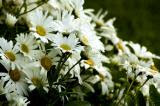


I have learned that because the Montauk daisies begins to green in the flower bed a month or two before the time to plant summer annuals, croci, pansies, daffodils or early tulips can be planted around the plant to take advantage of space later to be shaded by the growing stems.
They do need pruning and pinching off new stem growth in the spring and early summer should control their growth. The rule of thumb for the Montauk daisy is 'cut it in half on the first of June and again on the first of December.

The origin of this daisy: It was named Nipponanthemum, which roughly translated means Japanese flower. In the 1860s, a Russian botanist, Carl Maximowicz, brought the Nippon Daisy to his botanical garden in St. Petersburg. He distributed many of these plants around the world so that more people could study them and appreciate their beauty. The Nippon Daisy flourished well on Long Island and is now known in the United States as the Montauk Daisy.
The blooms of the Montauk Daisy last for a long time. They are also great as cut flowers because they have tall stems that are quite strong.

More on this flower in my next posting.

Sunday, October 17, 2010

Still blooming in October - 2010

A window box on my front porch has been happily blooming since May -
Nicotiana, pansies, alyssum and impatiens.


Sedum is plentiful in the Peace Garden along with Russian Sage
Let the Sedum stand during the winter months after they have turned brown,
they provide wonderful
viewing as they stand up straight during the snow.


The Japanese Anemone is flourishing well and is in it's full glory in October


Plenty of Cosmos still waving in the breeze


Jerusalem Artichoke is standing tall and in full bloom


Datura - Belle Blanche also called Jimson Weed


Morning Glory - Cardinalis


Moonbeam Coreopsis has been blooming for several months now and
is just starting going to seed.

*****
I am enjoying these flowers, however, the daily weather reports state that the temperatures are falling overnight so we will see how long they will be able to share their beauty with us.


Saturday, September 25, 2010

Jerusalem Artichoke


Jerusalem Artichoke

I first found this plant in my neighbor's garden in Massachusetts. He had a fire in his house and decided to demolish the site. He moved to Florida and told me to take any of the flowers that I wanted from his garden. These were alongside his fence and were very easy to transplant.
They are very durable and have survived fire, being transplanted and then again being transported to Western New York.

The Jerusalem artichoke was titled 'best soup vegetable' in the 2002 Nice festival for the heritage of the French cuisine. Despite its name, this hardy perennial is native of North America. Prepare the vitamin and mineral-rich roots as you would potatoes. Or enjoy their sweet nutty flavor by slicing them raw into a salad or a stir fry.


This perennial grows from 4 – 9’ tall. The tubers are gnarly and uneven, vaguely resembling ginger root, with a crisp texture when raw; they vary in color from pale brown to white, red or purple. The crop yields are high, Jerusalem artichoke also has a great deal of unused potential as a producer of ethanol fuel.

Harvesting should be done after the first frost. Dig the roots with a spading fork as needed. They are thin skinned so keep them moist until you are ready to eat them. The roots keep best in the ground, even over the winter.
Sir Walter Raleigh found Native Americans cultivating sunroots in what is now Virginia in 1585. When the sunchoke reached Europe in the early 1600s, thanks to Samuel de Champlain, it was known as the "Canada" or "French" potato.
Jerusalem artichokes are easy to cultivate, which tempts gardeners to simply leave them completely alone to grow. Even a small piece of tuber will grow if left in the ground, making the hardy plant a potential weed.
CAUTION: very invasive. Best planted next to a fence and the rear of the flower bed.

Here is a squirrel whose main purpose in life seems to be to bury peanuts and chestnuts in every part of my garden. He and his partner live in a tree in front of my house. They spend most of their time frolicking around the power lines and fence tops. We have learned to live in harmony together.


Saturday, September 18, 2010

Sedum and Garden Chores for September


Sedum Autumn Joy – Stonecrop

Drought tolerant perennials flourish well in full sun or light shade. They grow well in poor, dry soils. Zones 3 – 10. One to two feet in height

Their pink flowers turn a rusty red and remain colorful throughout the winter months. They can be increased by division or by rooting leaf or stem cuttings. Butterflies love sedum flowers.

*****

September is the best time to buy plants.

The garden centers need to clear their inventory of summer plants, trees and shrubs to create space for fall and holiday plants, so they reduce prices.

The cooler weather allows plants to expand their roots so it is an excellent time to plant peonies, and low maintenance perennials, such as hostas, daylilies and daisies. Independent nurseries generally have a larger discount than the mega stores. Also, stores like Home Depot, etc., return the unsold plants to the distributer and seldom reduce prices.

September chores for Zones 5 and 6.

Sow perennial and biennial seeds outdoors.

Remove spent blooms.

Prepare soil for fall planting.

Dig, divide and replant iris.

Divide and transplant spring flowering perennials.

Plant poppies and peonies.

*****

I have been very busy this past week gathering seeds from the flowers and making sure that I also gather the seeds from any weeds.

*** If you catch the weed seeds in time it will prevent your garden from being inundated by thousands of unwanted plants in the Springtime :-)


Tuesday, August 24, 2010

Japanese Anemone, Rose of Sharon, Jerusalem Artichoke, Blue Lobelia

Japanese Anemone hupehensis – Windflower - September Charm

Vigorous, erect, woody-based perennial – silver pink flowers edged with silver on tall stems. This spreading plant needs room to grow. Grows well in partial sun, however, my garden is full sun and they are doing well. Blooms late summer into fall. Height 2 – 3 feet and can get to 3 feet wide. Zones 5-8.Good cut flowers. Can be started by seed or by dividing established plants carefully in the Spring.


Minerva Rose of Sharon – Hibiscus - lavender

Originated in China and India. Plants grow 4 – 12 feet in height and in Zones 5 – 9. Require full sun and moist soil. Propagate from seedlings that appear around established plants. Most of these plants in my neighborhood were in full bloom during July and August. Mine have just started to bloom at the end of August – not sure why.


Jerusalem Artichoke – Helianthus tuberosus

Origin – North America introduce into Europe in 1617.
This perennial grows from 7 – 10 feet tall. They grow upright and flower in early autumn. This plant is grown for its edible root, however, I have never tried this. They love full sun. It is wise to plant them next to a wall or fence. Many consider it a weed because it grows rampantly.
Its long stems produce a yellow flower that can be used for cut flowers.
These flowers were given to me by a neighbor in Massachusetts.
They thrive just about anywhere.
Caution: plant this in an area that it can expand or you will find yourself pulling up many unwanted roots.


Great Blue Lobelia - Siphilitica– Cardinal Flower

Stiff stems up to 3 feet high. Bloom late summer through fall.
Zones 4 – 8.
Yet another flower that I brought with me from Massachusetts. They multiply rapidly but can be controlled by removing some of the new plants as they appear. Always a welcome addition of color later in the season with no need for special care.


Tuesday, August 17, 2010

Helianthus, Datura, More August Blooms


Helianthus

Bushy plant 3 - 5 ' tall. Loves the sun.
Propagate by division every three to four years in the spring.


Set at the rear of the border or in the center of an island bed.
These perennials make excellent cut flowers. Zones 5 - 9.


Datura - Belle Blanche
Also know as Angel's Trumpet

Origin - Mexico
Plant in full sun - grows 24" - 30"tall.
Large fragrant flowers bloom from summer until frost

Cleome and Monarda (beebalm)


Tuesday, August 10, 2010

Mallow, Obedient Plant,Liatris, Blue Mist Spirea, Scottish Thistle

Common Mallow - Malva Sylvestris

Shown on the right of the photo next to Purple Monarda. Originated in Britain. This robust perennial loves full sun. It blooms from spring to late summer. Herbal: leaves can be used as a substitute for tea and as a vegetable. Propagates by seeds.


Obedient Plant - Physostegia Virginiana

This plant is named 'obedient' because it appears to stand to attention at all times. It is an erect perennial plant that flowers mid-summer to early-autumn.
Likes full sun. Used in flowerbeds and borders.
CAUTION: this plant can be invasive and spreads itself by seed. I brought these from Massachusetts with me and I love them because they require no upkeep and they stand tall, however, they have a tendency to take over an area if you don't keep an eye on them.
Propagated by division or seed in the springtime. Zones 3 - 9.


Liatris Spicata - Gayfeather - Blazing Star

A strong perennial which grows to about 2 feet high. Flowers late summer to mid-autumn. Grows well in full sun and partial shade. Zones 3 - 9.


Blue Mist Spirea - Caryopteris Hybrid

This pretty perennial shrub loves full sun - grows to 3 feet tall.
Blooms in late summer to mid-autumn.
Has dark blue flowers which emerge from inky-blue buds.
Propagation by cuttings. Zones 5 - 9.


Scottish Thistle

Thistle is the common name of a group of flowering plants characterised by leaves with sharp prickles on the margins, mostly in the family Asteraceae. Prickles often occur all over the plant - on surfaces such as those of the stem and flat parts of leaves.

It is a strong and invasive plant which many consider to be a weed, trim flower heads before they set seed to control spreading of this plant in the garden. I usually let two or three plants bloom in my garden because being British I have a sentimental attachment to it.

The thistle became the official emblem of Scotland during the reign of Alexander III in the 13th century. It was first used on silver coins in 1470, during the reign of James II and was incorporated into the country's coat of arms in the 16th century.

So there you have it. You decide if you want them in your garden but be prepared to give them a wide berth when you are weeding because contact with the plant could be painful :-)

The flowers shown here all came into bloom this week and it is a coincidence that they are all a similar color but very pleasing to the eye.