Showing posts with label Purple Flowers. Show all posts

Saturday, June 11, 2011

More Blooms in June -2011 - Purple Flowers


This the entrance to my home -
As you can see I love purple flowers

The Blue False Indigo Plant


False Indigo


My neighbor's little dog 'Spice' poses in the Peace Garden


Japanese Iris

Purple Columbine -Aquilegia


Bearded Iris


Japanese Iris line the pathway.


Saturday, June 4, 2011

Blooms in June - 2011

Clematis (Nelly Moser)

Clematis ‘Nelly Moser’ is an heirloom hybrid gardened since 1897, & developed from Clematis lanuginosa , a Chinese species. The breeder was Marcel Moser of Versailles, France. He took his first bar-flowered hybrid, named for himself, & crossed 'Marcel Moser' with 'Belisaire,' and arrived at the name 'Nelly Moser.'

This perennial is easy to grow. If you open your hand as wide as you can stretch your fingers, you'll have before you the size of the flowers on a 'Nelly Moser' clematis.

I usually leave them outside on the vine but this year a stem broke off and I put it in a vase in the kitchen. As you can see when they did bloom they look really beautiful.

Cleome Spinosa

I plant very few annuals but I usually have a bed of Cleome Spinosa (Spider Flower)
Those above are just blooming but as the summer progresses they can get to 4ft tall and need no special attention.
They are propagated by seed. They love full sun but can thrive in half-shade also. Originated in Tropical America and were introduced into Britain in 1817.
They have a very strong odor and are sometimes referred to as the Gas Plant

Two winters ago I planted three Allium Grandiflora Lily bulbs. I had purchased the Allium at our local community co-op, Urban Roots. I was not sure what to expect but last Spring three came up and were small but beautiful.


This Spring they reproduced and multiplied in number. Six beautiful blooms came in bloom and they were very tall. Absolutely magnificent!


Now for the sad part of this story - they had been in bloom for only three days -
people were stopping by to admire them.

This morning when I went outside they were all missing. When I investigated I found them all on the ground scattered around in front of the house next door to me.

They had all been picked at the bottom of the stem but whoever did it threw them away. I can only guess that it may have been children - it was very disappointing to see them destroyed. I have not had an experience like this before but I have friends who have told me that people pick their garden flowers all the time without permission.

I miss them already :-(


Sunday, May 29, 2011

The Entranceway to my Home - Blooms in May

Hello friends!

I am glad to be back on the Peace Garden after a very long winter and a wet and chilly spring.

Today is reported to be the first day of uninterrupted sunshine in my town.

Yes, there has been so much rain that it has been difficult to work outside but most of us have been busy planning our window boxes and plant containers.


This window box is near my front door but also in my bedroom window. It is filled with pansies, impatiens, alyssum, petunias and vinca vines. It is the first thing that I see when I wake in the morning and I enjoy the view every day.


Here are some photos of my front porch as you enter my home.
All of the flowers here are annuals.

Nicotiana and petunias


Note the sweet potato vine in this planter - by the end of the season it will be trailing on the ground - It is a great accent to add to plant containers.


This hanging basket was a gift from my family on Mother's Day. :-)

I look forward to chatting with you over the next few months.

peacesojourner


Thursday, May 26, 2011

Blooms in May - 2011


Some of the first perennials are coming to life.
They have been snuggled under the heavy snow drifts for several months.
Mother Nature is just so amazing


Always one of the first flowers to bloom - Purple Columbine (Aquilegia)


The street that I live on is lined with Chestnut trees.
This one is directly in front of my house.


Two squirrels live in the tree in a well placed hole in the tree trunk. In the warm weather they live in a nest in the higher branches but when they are gathering nuts for the winter months they spend a lot of time in the tree trunk.

I enjoy observing them - they are so busy, playful and amusing to watch.


Ajuga - a beautiful ground cover that is great for those hard
to care for places in the garden. Also known as Bugle Weed.


Tuesday, August 10, 2010

Mallow, Obedient Plant,Liatris, Blue Mist Spirea, Scottish Thistle

Common Mallow - Malva Sylvestris

Shown on the right of the photo next to Purple Monarda. Originated in Britain. This robust perennial loves full sun. It blooms from spring to late summer. Herbal: leaves can be used as a substitute for tea and as a vegetable. Propagates by seeds.


Obedient Plant - Physostegia Virginiana

This plant is named 'obedient' because it appears to stand to attention at all times. It is an erect perennial plant that flowers mid-summer to early-autumn.
Likes full sun. Used in flowerbeds and borders.
CAUTION: this plant can be invasive and spreads itself by seed. I brought these from Massachusetts with me and I love them because they require no upkeep and they stand tall, however, they have a tendency to take over an area if you don't keep an eye on them.
Propagated by division or seed in the springtime. Zones 3 - 9.


Liatris Spicata - Gayfeather - Blazing Star

A strong perennial which grows to about 2 feet high. Flowers late summer to mid-autumn. Grows well in full sun and partial shade. Zones 3 - 9.


Blue Mist Spirea - Caryopteris Hybrid

This pretty perennial shrub loves full sun - grows to 3 feet tall.
Blooms in late summer to mid-autumn.
Has dark blue flowers which emerge from inky-blue buds.
Propagation by cuttings. Zones 5 - 9.


Scottish Thistle

Thistle is the common name of a group of flowering plants characterised by leaves with sharp prickles on the margins, mostly in the family Asteraceae. Prickles often occur all over the plant - on surfaces such as those of the stem and flat parts of leaves.

It is a strong and invasive plant which many consider to be a weed, trim flower heads before they set seed to control spreading of this plant in the garden. I usually let two or three plants bloom in my garden because being British I have a sentimental attachment to it.

The thistle became the official emblem of Scotland during the reign of Alexander III in the 13th century. It was first used on silver coins in 1470, during the reign of James II and was incorporated into the country's coat of arms in the 16th century.

So there you have it. You decide if you want them in your garden but be prepared to give them a wide berth when you are weeding because contact with the plant could be painful :-)

The flowers shown here all came into bloom this week and it is a coincidence that they are all a similar color but very pleasing to the eye.

Thursday, June 10, 2010

More Blooms in June

Hello dear readers - I have finally returned to the Peace Garden Blog after a long winter.

In the Spring the flowers started peeping through the soil but we have had so much rain that most only lasted a couple of days and were gone. Due to the rain the weeds are thriving and I have not spent enough time tending to the garden.

So, I am taking time to post this blog and will start to write at least weekly.


Purple Columbine -

Aquilegia


Iris


Dogwood Tree


White Japanese Iris


Bleeding Heart


Bearded Iris


Purple Japanese Iris


Monday, June 7, 2010

Blooms in June


Hide all


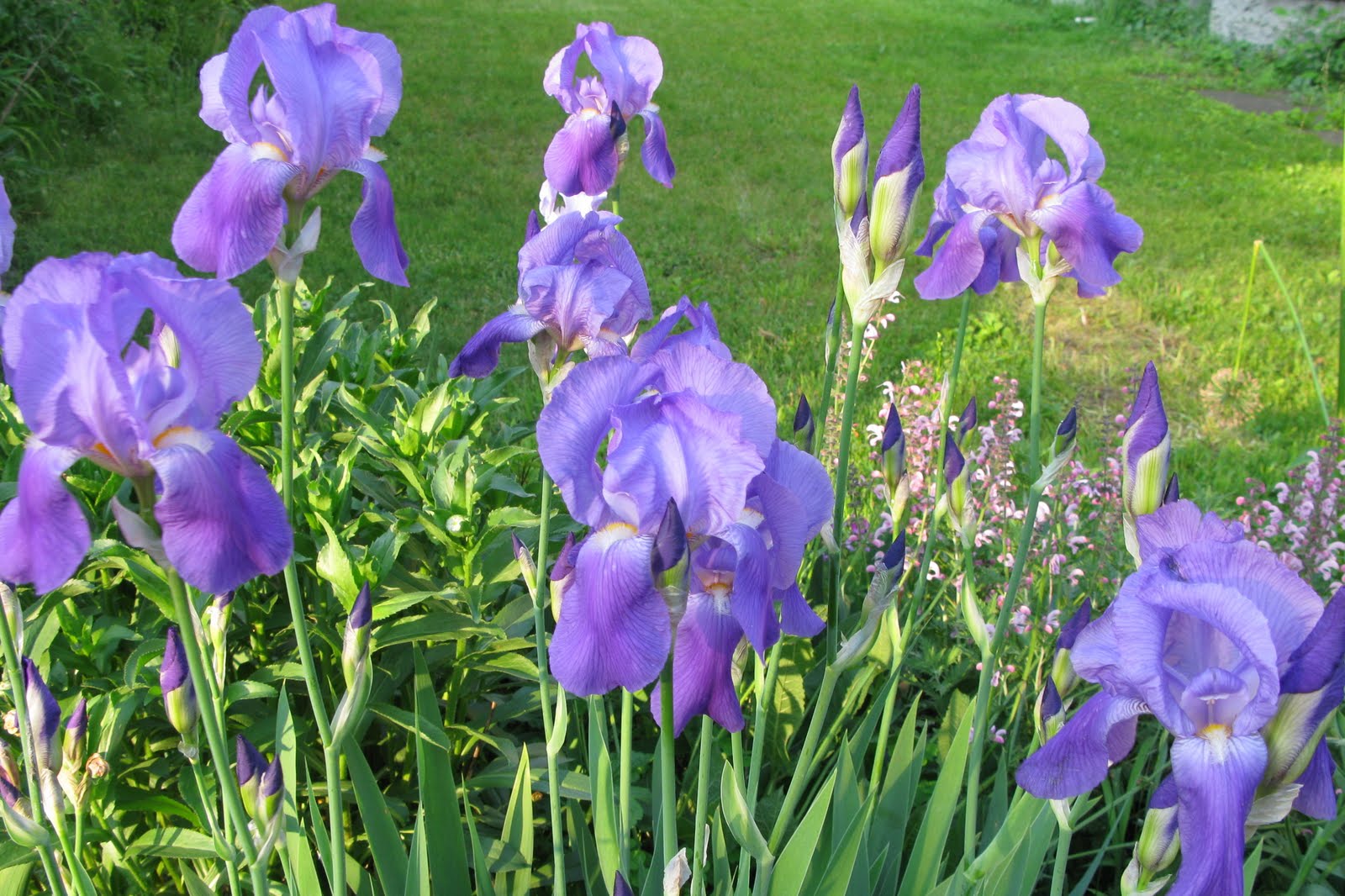
Bearded Iris – Iris (hybrids)

Iris – the word alone conjures up visions of brilliant spring flowers.

This large genus of about 200 species is native in the North Temperate regions of the world.

Iris have orchid-like flowers. 9 to 12 buds are usually found growing on short side branches on each stem. Each blossom lasts about three days.

Principle Iris colors are lavender, blue, white, purple, rose-red, pink, brown or various combinations and blends of these colors.

The two major requirements for successfully growing all classes of bearded iris are full sun and good drainage.

It is important to dig and divide every three to four years under ordinary culture.


Purple Columbine or Granny's Bonnet (Aquilegia x hybrida)
Columbines are very hardy perennials, and they thrive throughout the United States. Their nodding flowers vary in size from one to three inches across, and blossoms range in color from delicate pastels to deep, vibrant colors such as purple, yellow, orange, and red. The foliage is lacy, and attractive even when the flowers are not in bloom.
Most columbine flowers have backward-projecting spurs that contain rich nectar that can only be reached by hummingbirds. They can tolerate full sun in the North and require no special attention from me. Another gardener gave me some cuttings last autumn and they have established themselves well - they are magnificent!


The Blue False Indigo Plant

The blue false indigo, Baptisia australis, has been one of the most reliable and beautiful herbaceous perennials of them all. The leaves are unique and handsome, the flowers are purplish blue with a touch of gray, and the seed pods, at maturity are jet black and can be used in flower arrangements.

A native of the south central and eastern United States, this plant will grow in zones 3 – 9 However, it prefers fill sun and moist, rich soil. The blue false indigo plant features indigo colored flowers that in form resemble the lupine and annual sweet pea, but are not fragrant.

Additionally, the plants attract bumblebees and the seeds will feed the birds in winter. The Baptisia is deep rooted, long lived, slow growing, and will never invade the garden. The foliage is remarkably pest free and disease resistant.

Plant it all by itself in the garden so its special appeal can best be appreciated.

I have this one planted in the center of the lawn in the front garden. Passersby often stop to admire it and ask me what is it's name.


Chives

Chives (Allium schoenoprasum) are the smallest species of the onion family.

The Ancient Chinese have used chives for thousands of years, and it is reported that Marco Polo brought them to Europe from China.

An herb is a plant whose leaves, seeds, or flowers are used for flavoring food or in medicine. Referred to in the plural, as chives. Culinary uses for chives involve shredding its leaves (straws) for use as condiment for fish, potatoes and soups. It has insect-repelling properties, which can be used, in gardens to control pests.

The mauve colored flowers are also edible.

Chives are hardy perennials, they prefer sun and well-drained soil and require little attention.

A fellow garden lover gave these to me. I have several clumps of them around the garden & I love them because they provide attractive color and require no care whatsoever. You can’t get any better than that!


Clematis

I have had good results with the Nelly Moser Clematis. It is a flowering vine that can reach as much as 12 feet in length, with off-shoots from the main vine reaching out 3-4 feet. Best displayed on a trellis, arbor, or other climbing fixture, the blooms start in late May and can continue all summer long. Clematis are easy to grow, fast growing, and suitable to USDA hardiness zones 4a to 8b.

Water weekly unless there’s a soaking rain.


If you are fearful or are uncertain about pruning, you can skip it. The purpose of pruning is to neaten up the plant and to encourage new growth. In time, even an unpruned clematis will fill out. This plant is beautiful.


My garden is on a small city lot (28' wide). The main colors in the garden are purple,lavender, yellow, pink and white. The flowers that you see above are the first to bloom this year and it is interesting that they are all in shades of lavender to purple, which has a very pleasing effect.

I brought the iris and false indigo with me from my garden in Massachusetts.

Saturday, November 7, 2009

November Chores


Here in Western New York we have been blessed with a few days of unseasonably warm weather so I have been busy spending time outdoors doing those many last minute chores that seem to never go away.

I haven’t mentioned before that I am a frugal gardener and rarely purchase anything unless it is at a drastic reduction. This is usually the time that I go perennial shopping and looking for bargains.

Two weeks ago I was at a local mega-home store that had just put all of their perennials on sale at 80% off. So I purchased 2 Autumn Joy sedum, 4 Russian Sage, 3 Piilu Clematis, 1 very large Azalea, 2 large Spiraea ‘Goldflame’, 3 Hens and Chicks, 2 Heuchera Coral Bells. 17 perennials in all for less than $30 total. They are now planted and look like they will thrive well.

I don’t usually plant many spring bulbs but I have always planted crocus near my front door. In the early springtime, even when snow is still on the ground, the little crocus is always faithful and peeps through the snow. It never fails to make me happy and puts a song in my heart at a time when I am feeling that winter will never end.

This weekend I planted three Allium Grandiflora Lily bulbs and a bed of croci. I purchased the Allium at our local community co-op, Urban Roots. Now that they are in the ground I look forward to seeing the blooms next year, so in anticipation, I have posted a photo of this flower above. J Isn't it beautiful?

There are probably only a few more days of gardening time in this area but here are some things to check for:

1. Edge your perennial beds and continue gathering seeds that are now dried and have turned dark brown or black.

2. Remove any perennial weeds that have invaded the garden.

3. It is amazing that I still have some Dandelions blooming in November. Make sure that you remove any annual weeds that are going to seed. Throw these in the garbage, not in the compost pile or next year there will be ten times as many.

4. Take pictures, make notes, and if you haven’t done this already - start a scrapbook or do anything at all that allows you to remember the past season with its successes and failures in detail.

5. Scope out to see if you have any plants that should be moved to another area. You can even just mark the plants for moving next spring by using that brightly colored surveyor's flagging tape.

However, moving or dividing perennials in the autumn is a great way to reduce your work next spring. The cool, moist weather is an ideal time for perennial roots to become well established, even in cold-winter regions. Peonies are best moved or divided in the fall only.

Well, it is 62 degrees today so I am off into the garden to see what else I can do. I am already becoming wistful at the idea of only working indoors for the next few months. No I don’t mean housework – I am planning to do more writing J


Thursday, September 3, 2009

The Cycle of the Blue False Indigo Plant

The Blue False Indigo Plant

This is to document the growth of this plant. The photo above shows how it appears early in June.

The blue false indigo, Baptisia australis, has been one of the most reliable and beautiful herbaceous perennials of them all. The leaves are unique and handsome, the flowers are purplish blue with a touch of gray.


This photo shows the early blooms starting on the branches. This flower is one of my favorites in the garden.
I first saw it in the garden of a woman in a village in Massachusetts. She was showing us around her English style cottage garden when I spied the Blue Indigo plant. She was offering some of her plants for sale and I asked her if I could have this one. She refused, saying that she loved it so.


The woman finally agreed to let me have the plant. This was at least 15 years ago and I have been taking it with me whenever I move. So it is now in the center of my front garden in Western New York and has weathered the harsh winter very well.
Here it is in full bloom
The plants attract bumblebees. The Baptisia is deep rooted, long lived, slow growing, and will never invade the garden. The foliage is remarkably pest free and disease resistant.
Now we are blooming in the month of July and the plant is still doing very well.


Plant it all by itself in the garden so its special appeal can best be appreciated. Isn't it beautiful?
I have this one planted in the center of the lawn in the front garden. Passersby often stop to admire it and ask me what is it's name.

In early August the seed pods are starting to turn into these wonderful light green velvety pods.
A native of the south central and eastern United States, this plant will grow in zones 3 – 9 However, it prefers full sun and moist, rich soil.


The blue false indigo plant features indigo colored flowers that in form resemble the lupine and annual sweet pea, but are not fragrant.

At maturity the seed pods become jet black and can be used in flower arrangements.

The seeds will feed the birds in winter and the seeds can also be planted for new blooms.


So there you have the cycle of life of the Blue Indigo. They are beautiful at each cycle of growth.
Now it is the month of September and the season's cycle is coming to an end.
How wonderful it has been to watch Nature's gift to us.