Showing posts with label Blooms in July. Show all posts

Tuesday, July 27, 2010

Buffalo Garden Walk - 2010 - Another Neighbor's Garden


Nicholas lives directly across the street from me


His garden is an excellent example of inner city creativity


He has a blend of perennials, annuals and vegetables


Lavender and Feverfew are a perfect blend along the pathway


His garden was featured on the front page of the local Buffalo News.
Because of this many of the more than 50,000 visitors to Buffalo started their
Sunday viewing on our street


The viewers range from families pushing babies in strollers to people in their 90's - they come from as close as next door, from the same city and from all 50 states and several different countries. Canada is just a ride over the Peace Bridge from us so many, many Canadians make that ride over.


Next year make sure that you mark your calendars for the last weekend in
July so that you can pay us a visit in Buffalo


Monday, July 26, 2010

Buffalo Garden Walk - 2010 - My Neighbor's Garden


My neighbor Bruce is an artist and he displays his talents
in his garden and around his home.


A beautiful Hibiscus painted directly onto the window screens.


Each window has a window box filled with pink geraniums


A creative display of flower pots that most of us would just discard


Bruce has painted roll down bamboo screens with gorgeous floral
scenes that pull in the colors of the woodwork around the house.
They are a joy to anyone who happens to be passing by.

There are also tree planters that bring color to the garden and objects of interest (marbles, coins, teaspoons,in fact - anything that happens to be laying around is included) are cemented into the pathway along the side of the house.

Sunday, July 25, 2010

Buffalo Garden Walk - 2010 - The Hope Blooms Garden


This vehicle is provided free of charge to walkers who wish to
explore all areas of the expansive Garden Walk in Buffalo New York.


The 'Hope Blooms' garden is located alongside the AIDS Community
Services Victorian Mansion.


The garden was started seven years ago and has become a place of serenity and
refuge for those infected and affected by AIDS.


A bee is gently pausing on the Echinacea Purpurea


Liatris Spicata - Blazing Star: Gayfeather


One can walk along the 'Memory Path' that runs through the garden -
the bricks
record the names of those who have gone before us.

Monarda - Bee Balm and Mint

photos by peacesojourner


Saturday, July 24, 2010

Buffalo Garden Walk - 2010


The 16th Annual Buffalo Garden Walk is the largest garden tour in the United States
It is a free, self guided tour of more than 350 gardens.


Allentown is a local section of Buffalo known for its Arts and Crafts and
colorful, eclectic flavor.


As people exit the local underground public metro transportation they are
greeted by the beautiful floral display pictured here.


Held annually on the last weekend of July, the Garden Walk has become one of Buffalo/Niagara's most anticipated summer events.


Russian Sage, Echinacea Purpurea, and Black-Eyed Susans are in full bloom.

Welcome to Buffalo

photos by peacesojourner

Wednesday, July 14, 2010

Blooms in July - 2010

Shasta Daisies


Botanical Name: Campanula carpatica
Common Name: Bellflower, Harebell or Canterbury Bells


Sweet William attracts butterflies


Chicory and Day Lilies

Chicory is an herb and considered a weed by some gardeners, however, I like to see them interspersed among the perennial flowers. They are beautiful to the eye and the color is magnificent.


Chicory

Common chicory (Cichorium intybus) is a bushy perennial herb with blue, lavender, or occasionally white flowers. It grows as a wild plant on roadsides in its native Europe, and in North America and Australia. Common chicory is also known as blue sailors, succory, and coffee weed.

Herbal use

Chicory (especially the flower) was used as a treatment in Germany, and is recorded in many books as an ancient German treatment for everyday ailments. It is variously used as a tonic and appetite stimulant, and as a treatment for gallstones, gastro-enteritis, sinus problems and cuts and bruises.

The chicory flower is often seen as inspiration for the Romantic concept of the Blue Flower.


Chicory and Day Lily

photos by peacesojourner

Saturday, July 3, 2010

Tomato plant, Cleome Spinosa, White Clover - July 2010

Grape Tomatoes
growing in a hanging basket.
I am trying something a little different this year. I usually plant tomatoes in patio pots.
These seem to be thriving well and are certainly easier to maintain.


A cluster of blooms -

Montauk Daisy, Heuchera (Coral Bells) and Russian Sage


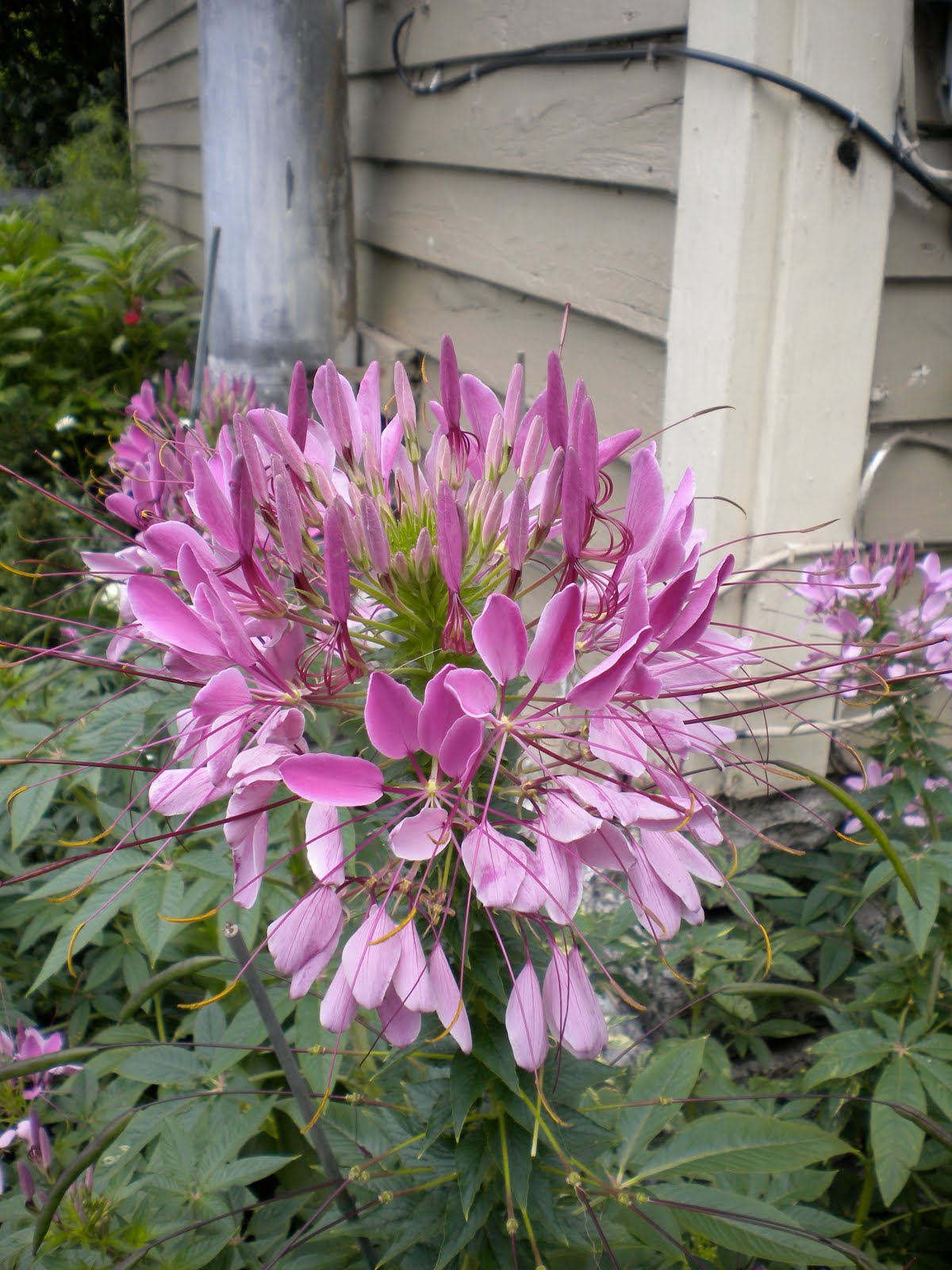
Cleome Spinosa

I plant very few annuals but I usually have a bed of Cleome Spinosa (Spider Flower)
Those above are just blooming but as the summer progresses they can get to 4ft tall and need no special attention.
They are propagated by seed. They love full sun but can thrive in half-shade also. Originated in Tropical America and were introduced into Britain in 1817.
They have a very strong odor and are sometimes referred to as the Gas Plant

White Clover

When I moved here I had an entire fallen tree laying on the total area of the small lawn.
The tree had been there for some time (since the October Storm). When it was finally removed all of the grass was gone and only a few weeds survived.
I threw down some random grass seeds and little by little the lawn showed up. What I wasn't expecting was so much clover. As you can see it covers a very large area. What I have discovered is that it is a terrific substitute for grass. It aerates the soil, regulates nitrogen, and doesn't need fertilizing. It is also attractive, needs less mowing, attracts (good) pollinators, stays green during the heat of the summer and it is drought tolerant.
I will let you know how it progresses.


My organic magazine suggests 8 ounces of seed per 1,000 square feet.This perennial is sown in Spring or Summer so I am planning to add more seed to the still barren areas and will see what happens.

If you like to walk barefoot White Clover is also easy on the feet.


A small bouquet of the Shasta Daisies

*****

July Chores

  • This is the perfect time to bring those seedlings outdoors and transfer plants from pots into the ground.
  • potted roses, shrubs, trees, ground covers, vines, and perennial and biennial herbs. Flowers, shrubs, trees, ground covers, and vines should all be planted now.
  • Sow perennial and biennial herb and flower seeds outdoors.
  • Sow seeds outdoors for succession plantings.


photos by peacesojourner

Wednesday, September 23, 2009

Yellow Trumpet Vine


The Yellow Trumpet Vine


This is the time of year when most gardeners roam around their gardens and start to evaluate what was successful this past summer and what did not do well.

Last year I purchased a Yellow Trumpet Vine from a local Family Garden Center. I chose this particular plant because I had seen one while touring the local Garden Walk some time ago. I had erected a new garden fence and wanted to have a quick cover of flowers on the back fence wall.
Well it was planted as directed and here we are 18 months later and nothing has happened. Not a flower in sight.

The photos shown above are of a thriving Yellow Trumpet Vine. I thought that I would show the photos to remind me what it was that I was expecting to see.

After some research I discovered that this is a common problem with this plant.
On a conversational website I read complaints from several readers who stated that the vine sometimes takes 3 years to flower. Some even stated that they had their plant for 10 years with no flowering. So, I am declaring this vine as not doing well this year and I guess that I will wait another year (or two, or three) to see if it blooms.

I also read that the vine is so invasive that it can actually destroy the foundations of houses or garages. I am safe at the moment as the vine that I planted is about 80 feet from the house. another hint I received was to purchase a product called Vine-X that will actually kill a Trumpet Vine. (www.vine-x.com)

No, I am not planning to murder it at this time - I am in a 'wait and see' mode with the vine but thought that this information might be useful to those who have just given up on it. :-)

The redeeming hope for me is the actual beauty of the Yellow Trumpet Vine. As you can see in the photos above it is a plant to admire even though it seems to have some hidden problems not apparent to the eye.

*****

If you have any suggestions for me please comment - it will be appreciated.

Friday, July 31, 2009

A walk around the Peace Garden at the end of July

Buffalo  in Bloom


Side Garden


Front Garden


Rear Garden


You will notice that the primary colors that I choose in the Peace Garden are pastels. 
Pink, lavender, blues, yellow, white. 
The only splash of brighter colors are the Day Lily with bright orange or deep red colors. 
This is how the garden looks on this, the last day of July.